
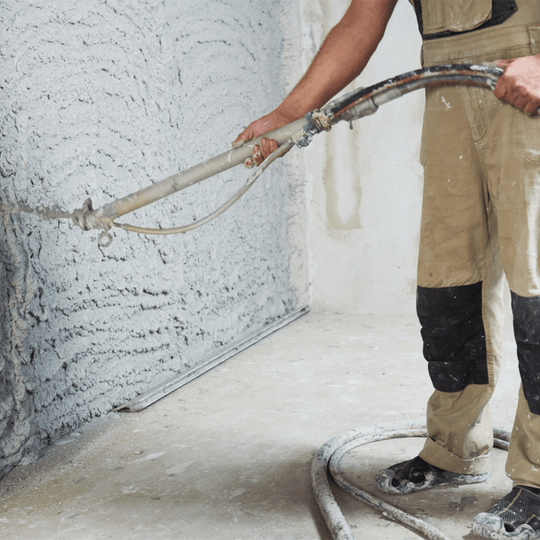
If you’re thinking about renovating your home or are already in the middle of it, you may have heard of “machine plastering.” But what exactly is it? How is it done? What are its advantages and disadvantages compared to traditional plastering? In this article, we’ll cover the most important aspects of machine plastering so you can decide whether it’s the right method for you!
Table of Contents
- Machine plaster vs. traditional plaster.
- Machine plastering – what is it?
- How is machine plastering done?
- Types of machine plasters.
- Pros and cons of machine plasters.
Applying plaster is one of the finishing works carried out after construction is complete. It can be used on both interior and exterior walls, including ceilings, as well as on other elements requiring protection, such as decorative treatments, etc. Plasters are designed to protect the structural integrity of a building while also enhancing its aesthetics and adding to its charm!
1. Machine plaster vs. traditional plaster
There are two main types of plastering: traditional plastering and machine plastering. Traditional plaster is applied by hand, whereas machine plaster is applied using a specialised plastering machine.
2. Machine plastering – what is it?
Machine plasters are becoming increasingly popular due to the many benefits they offer. Machine plasters are made by mixing a ready-made dry plastering compound with water inside a plastering machine.
This results in a much smoother and more uniform finish than traditional hand-mixed plasters.
In addition, machine plasters can be applied faster and more evenly than hand-applied plasters, resulting in a more refined finish.
Machine plasters also offer greater design flexibility, as they can be mixed with various colours and textures to create unique effects.
Finally, machine plasters are far less labour-intensive than traditional hand-applied plasters, making them a more cost-effective solution for both businesses and homeowners.
Our recent machine plastering projects
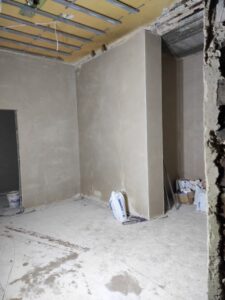
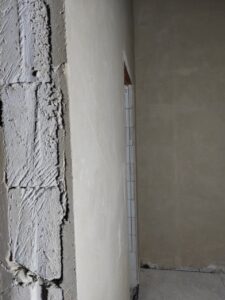
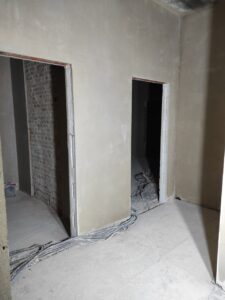
3. How is machine plastering done?
With machine plastering, the process begins at the mixing unit, where the dry compound is combined with the appropriate amount of water. Once thoroughly mixed, the mixture is poured into the tank of the plastering machine. From there, the plaster is evenly distributed across the surface being worked on. For the process to run smoothly, it is important that the machine is connected to a steady power and water supply — this prevents the plaster from drying out too quickly or becoming too thick. With the right care and attention, machine plastering can be a fast and easy way to achieve a professional finish.
4. Types of machine plasters
Machine plasters are also distinguished by their composition, with the most common types being lime, gypsum, and cement-lime.
Each type of plaster has unique properties and advantages that make it suitable for different applications. For example, lime plaster is typically used on exterior walls as it is resistant to freezing temperatures. Gypsum plaster is often used inside buildings because it is easy to work with and provides a smooth finish. Cement-lime plaster, on the other hand, is a popular choice for both exterior and interior walls due to its durability and good adhesion. Whatever type of plaster you choose, make sure to select the one that best suits your needs.
5. Pros and cons of machine plasters.
-
Uniformity of the finished product and mix quality
When it comes to plastering, one of the most important factors to consider is the uniformity of the finished product. This is especially important when working with plaster on a large scale, as even a small difference in quality can have a significant impact on the overall appearance of the project. Fortunately, machine plasters are far more consistent in quality, as they are produced from a uniform mix that delivers the same results across all surfaces. Mixer-prepared plasters, on the other hand, can vary in quality from batch to batch, making it difficult to achieve consistent results. For this reason, machine plasters are generally the best choice for those seeking a high-quality, uniform finish.
-
Completion time
Machine plasters are applied significantly faster than traditional ones. An average-sized house can be plastered within two to three weeks by a crew using a plastering machine. With a traditional plastering crew mixing plaster in a cement mixer, the same job could take up to two months. The main reason for this difference is that traditional plasters need to be mixed with water before application, whereas machine plasters come ready-mixed and only need to be applied directly. Since machine plasters are ready to use, they save a great deal of time. They can also be applied far more evenly and smoothly, which further speeds up the completion of the work. If you want to have your home plastered quickly and efficiently, choose machine plastering.
Summary
Machine plastering is a faster and more efficient method of applying plaster than traditional plastering. The finished product is more uniform, of higher quality, and the completion time is shorter. If you’re looking for a professional company in Warsaw, be sure to order machine plastering Warsaw from our company!
At BestRemonts, we offer a wide range of renovation and construction services. Find all of our services here. Whether you need help with a small renovation or a complete home refurbishment, our team of experts is here to help.
We offer competitive rates and a free renovation quote, so you can get the work you need done without breaking the bank. We are also always available to answer any questions about our services. So if you need a trusted and reliable renovation or construction company, look no further than BestRemonts. Contact us today to find out more about what we can do for you.